Veteran banker urges ‘strategic paranoia’ as delayed oil price impact from West Asia conflict set to hit consumers, widen current account deficit
New Delhi, May 12, 2026 – Uday Kotak, founder and non-executive director of Kotak Mahindra Bank, has sounded a strong alarm for India’s economy, urging businesses, policymakers, and consumers to “prepare for the worst” amid the ongoing US-Iran conflict in West Asia.
Speaking at the Confederation of Indian Industry (CII) Annual Business Summit 2026 here on Tuesday, Kotak warned that the full economic fallout — particularly from surging energy prices — has been delayed for nearly two-and-a-half months but is now imminent. “We have not seen the impact in the last two months of the Middle East war in terms of energy price transmission. It’s coming, and it’s coming big,” he said. “The consumers have not felt the pressure at all… The shock is coming… I don’t think you’re very far away from the shock unless the Iran war stops tomorrow morning.”
Oil companies have so far absorbed much of the higher crude costs using older inventories, acting as a temporary shock absorber. But that buffer is ending, Kotak noted, and the pain will soon transmit to households — especially those with limited incomes — through higher fuel prices and knock-on effects on everyday essentials. “Think about a consumer with limited income, having to spend more directly on fuel and indirectly on other items dependent on fuel,” he added.
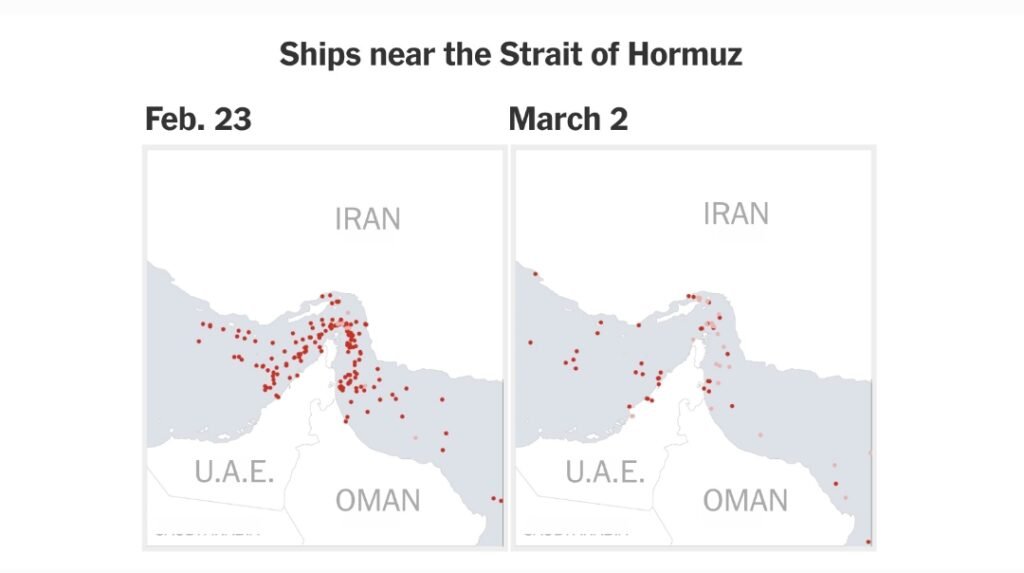
India imports more than 85-89% of its crude oil requirements, making it highly vulnerable to disruptions in global supply chains. The conflict has already affected shipping through the Strait of Hormuz, a critical chokepoint for Gulf oil exports that India relies on heavily.
Map showing reduced shipping traffic near the Strait of Hormuz amid escalating tensions (Feb-Mar 2026).
Kotak pointed out that India’s current account deficit (CAD) remains manageable at around 1% of GDP when oil hovers near $60 per barrel. However, if prices climb toward $100 a barrel — a real risk given the volatility — the deficit could widen sharply to 2.5% of GDP, requiring about $150 billion in annual financing and putting pressure on the rupee, inflation, and growth.
A call for “strategic paranoia” in a “tribal” world
Beyond the immediate oil shock, Kotak painted a broader picture of a global order shifting from post-1945 cooperation to a more fragmented, “tribal” mindset reminiscent of the pre-World War II era. “We are seeing a mindset of who will control what. In a tribal world, it matters who controls assets,” he said. Nations are now competing intensely for control over trade routes, physical assets, and strategic chokepoints — amplified by the AI revolution and geopolitical realignments.
He urged India to adopt what he called “strategic paranoia” before events unfold: “My view is we should prepare for paranoia before the event. We must prepare for the worst.” This includes moderating unnecessary consumption, strengthening the national balance sheet, focusing on long-term nation-building rather than quarterly profits, and accelerating self-reliance in energy, manufacturing, and innovation. “We need to get ready for tough times rather than waiting for the shock to hit us,” Kotak emphasised.
His remarks come days after Prime Minister Narendra Modi appealed to citizens to conserve fuel, opt for work-from-home where possible, avoid non-essential foreign travel, and postpone luxury purchases like gold amid global uncertainty.
Background: The US-Iran conflict and energy markets
The warnings arrive against the backdrop of a fragile US-Iran ceasefire that has been on life support since late February 2026, when US and Israeli strikes targeted Iranian facilities. Shipping through the Strait of Hormuz — which handles about 20% of global oil trade — has been severely disrupted, driving up Brent crude prices and creating uncertainty even as markets have shown some resilience in recent weeks.
Kotak’s message echoes his earlier April 2026 comments at a FICCI event, where he flagged the risk of a “return to global colonialism” amid rising hard-power politics and control over key assets like Hormuz.
Market reaction has been cautious, with stocks, the rupee, and bond yields showing volatility in recent sessions.
Analysts say Kotak’s call for preparedness is timely. While a swift resolution to the conflict could ease pressures, the probability of structural shifts in global energy and trade remains significant. For now, the advice from one of India’s most respected bankers is clear: hope for the best, but prepare for tough times ahead.
Leave a Reply