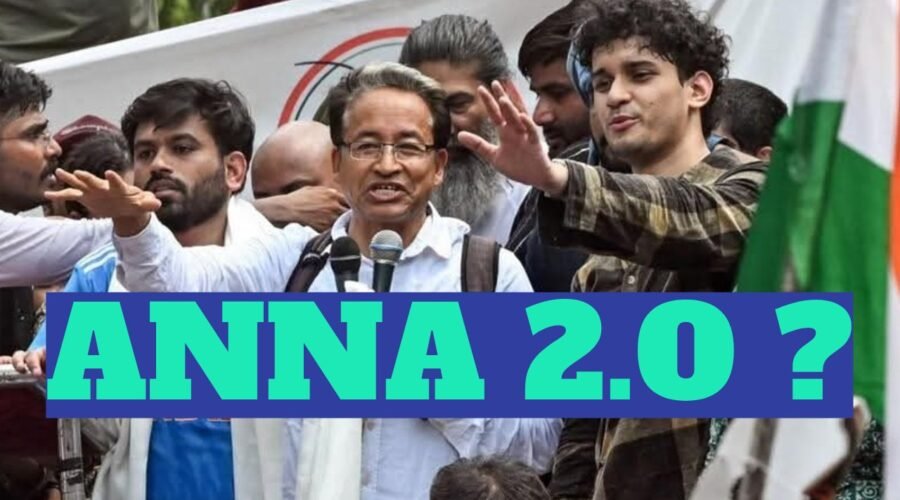
While Congress workers in Vadodara were detained by police before they could even begin their agitation against Education Minister Dharmendra Pradhan and the NEET paper leak scandal yesterday (June 5), the Cockroach Janta Party (CJP) received what many are calling a “red carpet” welcome in Delhi today. Organizers got permissions, a prime Jantar Mantar venue, massive media attention, and high-profile backing — including from Ladakh activist Sonam Wangchuk — for their June 6 protest demanding Pradhan’s resignation.
The Cockroach Janta Party (CJP) — born from a Supreme Court judge’s “cockroaches/parasites” remark about unemployed youth — staged its first major street protest on June 6, 2026, at Jantar Mantar in Delhi. Thousands gathered peacefully under the cockroach logo banner demanding Union Education Minister Dharmendra Pradhan’s resignation over the NEET-UG 2026 paper leak scandal, exam irregularities (NEET, CUET, CBSE), and broader failures in the education system that have devastated over 2 million students, triggered suicides, and shattered trust in merit-based systems.
Climate activist and Ladakh icon Sonam Wangchuk flew in from Leh to join, stating his participation would strengthen — not dilute — ongoing movements for justice, including Ladakh’s long-standing demands for constitutional safeguards and statehood. He has positioned it as solidarity with India’s youth on education and opportunity.
Is This Anna Hazare 2.0?
Superficial parallels exist. A respected, seemingly “apolitical” or Gandhian-style figure (Wangchuk, with his history of hunger strikes, ice stupas, and SECMOL education innovation) lends moral weight to a mass peaceful mobilization against perceived systemic rot — much like Anna Hazare’s 2011 anti-corruption fasts that tapped middle-class anger against UPA-era graft and catalyzed political shifts, including AAP’s rise.
Key differences undercut the clean “Anna 2.0” label:
- Anna’s movement was broad-based anti-corruption with massive middle-class and some RSS/VHP support.
- CJP is a Gen-Z satirical meme that turned IRL, laser-focused on one minister and exam integrity failures amid high youth unemployment.
- The political context is inverted: 2011 targeted a tired Congress-led regime; 2026 targets a BJP government with its own strong youth outreach history.
Wangchuk’s involvement adds gravitas and cross-issue appeal (Ladakh + pan-India education), but it also risks framing him as a national opposition face rather than a Ladakh-specific crusader.
Is the Cockroach Movement a Vehicle to Reestablish AAP?
Founder Abhijeet Dipke (Boston University graduate, returned to India for the protest) worked as a social media strategist/volunteer with AAP from 2020–2023, including meme-based digital campaigns for the 2020 Delhi elections and some education-related work. He has publicly distanced himself from current AAP ties, saying he left years ago to study abroad and is running an independent satirical movement.
No smoking-gun evidence shows direct AAP funding, control, or orchestration of CJP today. However, the optics fuel speculation:
- AAP has long owned the “education + youth + anti-corruption” space (Delhi government model).
- Exam paper leaks and institutional failures are potent wedge issues that hurt the ruling dispensation and could indirectly revive AAP’s relevance or provide a new vehicle/pressure group.
- Some political commentary and social media explicitly frame Wangchuk + CJP as potential “Anna 2.0 for AAP benefit.”
It could be organic youth anger meeting political opportunity — or a more calculated play. In India’s hyper-polarized ecosystem, both interpretations thrive. CJP’s rapid virality (claimed 1M+ online members) shows genuine resonance with students and unemployed youth tired of repeated scandals.
Who Is Sponsoring Them?
No verified evidence of large-scale foreign or shadowy funding for the current CJP protest wave. It has been driven primarily by social media virality, meme culture, and Dipke’s communications skills.
For Sonam Wangchuk:
- His organizations (SECMOL/HIAL) faced intense FCRA scrutiny and license issues during the 2025 Ladakh protests (revoked amid allegations of dubious foreign funds and “anti-national” activities). Supporters counter that income came from legitimate research, innovation exports, and domestic sources — no proven violation.
- Wangchuk was detained in 2025 during Ladakh unrest (later released) and accused of inciting violence in some narratives.
These are recycled allegations common in Indian politics whenever activists challenge the state on sensitive issues (Ladakh’s border sensitivity + autonomy demands). Transparency on funding for all activist/NGO/political movements remains poor across the spectrum.
The Protest Treatment Contrast: Lathi, Water Cannons vs “Red Carpet”?
The contrast is stark and locally visible too. In Vadodara, Congress workers planning to agitate on the same NEET-Pradhan issue were picked up before they could even start yesterday. Similar patterns played out in Jaipur and other cities where Congress marches faced water cannons and lathi when they tried to reach BJP offices.
In Delhi, however, the CJP’s June 6 Jantar Mantar protest — with high-profile support including Wangchuk — was permitted at the capital’s traditional protest site. Organizers emphasized “peaceful protest,” sought and received permissions, and maintained discipline. Large police deployment occurred, but reports describe it as largely incident-free with significant media space and attention.
Why the difference?
- Location and method matter: Designated protest grounds (Jantar Mantar) vs attempting to march on party HQs or gherao offices.
- Nature of crowd: Viral, youth-led, meme-framed, high-profile celebrity/activist support vs traditional opposition party workers.
- Political calculus: Cracking down hard on a rapidly viral Gen-Z movement risks creating martyrs and amplifying it further; established opposition parties often face standard (sometimes harsh) public-order protocols.
- This does not prove a grand conspiracy, but it does highlight inconsistent application of protest management rules — a recurring complaint across governments in India. Democracy suffers when enforcement appears selective based on who is protesting and how viral they are.
Bottom Line – Truth Over Narrative
Genuine grievances exist: Repeated exam paper leaks, cancellations, re-exams, and institutional opacity have real human costs — lost years, mental health crises, and eroded faith in “merit.” Youth demanding accountability from the Education Minister is legitimate. Wangchuk bringing attention to education alongside Ladakh issues is within his rights as a citizen-activist.
At the same time, questions about political intent, past associations (Dipke’s AAP history), and funding transparency are fair and should be scrutinized — not dismissed as “anti-youth” or “pro-government.” Movements that start satirical or issue-based can be co-opted; the Anna-to-AAP arc is the textbook example.
The real test is outcomes: Will this pressure deliver concrete reforms (NTA overhaul, exam integrity mechanisms, youth employment focus) or simply become another chapter in India’s endless political theatre?
Protest rights must apply uniformly — to Congress workers in Vadodara, CJP “cockroaches” in Delhi, Ladakh activists, and everyone else — without preemptive detentions for some and facilitated space for others. Selective outrage on either side weakens the democratic fabric.
India’s youth deserve better than leaks, spin, and selective policing. They also deserve movements that remain transparent about their backers and true to their stated goals. The cockroaches have crawled into the national conversation. What happens next depends on whether this stays about fixing education — or morphs into something else entirely.
The evidence so far shows a potent mix of real anger, clever meme politics, past political linkages, and the eternal Indian question: Cui bono? (Who benefits?).
Leave a Reply