

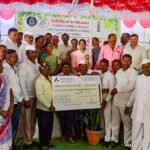
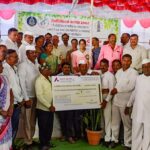
Nashik: Soil bacteria in Dapur (Tal. Sinnar, Dist. Nashik) have grown ‘gold’ for the village and are making it prosperous. As per the provisions of the Biodiversity Act, 2002 (Access and Benefit Sharing – ABS), the Biodiversity Management Committee of the villagers has received an amount of Rs 6,769,359 from a company that commercially uses enzymes produced using bacteria obtained from soil bacteria (Bacillus coagulans) in this village. This amount was distributed to the villagers at the Dapur Gram Panchayat Hall on Saturday (February 28). This is the first successful incident in the state.
As per the provisions of the Biodiversity Act, this amount received by the local Biodiversity Committee will be used for the development of the villagers and the protection and conservation of biodiversity. The distribution of this amount was done in the presence of Ravindra Wankhede (B. V. Sec.), Project Officer of Maharashtra State Biodiversity Board.
The programme was attended by a large number of villagers, including Siddesh Sawdekar, Deputy Conservator of Forests (Nashik West), Nashik; Ravikant Dengre, Director Maharashtra Gene Fund (Special Work); Poonam Pate; and Extension Officer, Panchayat Samiti Sinnar, Machhindra Kagne.
How was the amount received?
The bacteria Bacillus coagulans found in the soil of Dapur village and the enzyme obtained from it were used by Advanced Enzyme Technology Ltd for commercial production. As per the provisions of the Biodiversity Act, the local committee has the right to distribute the benefits. Based on these provisions, the benefit distribution process was implemented in 2014 and 2015 as per the guiding rules. Accordingly, this amount was received from the company. This amount has been deposited in the account of the Biodiversity Management Committee in Dapur.
Features of the programme
The programme was attended by a large number of villagers, Gram Panchayat members, office bearers of local government agencies, and forest department officials. Dr Bharat Singh Hada, Member Secretary, National Biodiversity Authority, guided the programme. Siddhesh Sawdekar led the programme as DFO. He said, “This successful event in Dapur has given financial strength to the committee that protects and conserves biodiversity at the local level. This amount will be useful for the development of the villagers, for biodiversity conservation and at the local level.”
The company that uses these bacteria commercially gave this amount to the committee by following the provisions of benefit sharing.
DFO Siddhesh Sawdekar said, “This amount has provided financial strength for the protection and conservation of biodiversity at the local level. The villagers should use this amount appropriately to develop the village.”
The villagers of Dapur have expressed satisfaction over this successful event and have expressed their desire to cooperate in the future for the conservation of biodiversity. This event has become a model for other villages in the state.