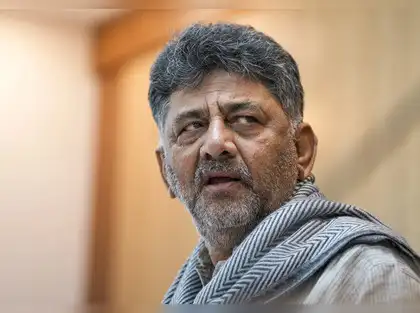
In the high-stakes arena of Karnataka politics, few figures embody resilience, strategic acumen, and raw organizational muscle quite like Doddalahalli Kempegowda Shivakumar, popularly known as DK Shivakumar or DKS. As of late May 2026, the man once dubbed the “Tiger of Sathanur” stands on the cusp of his greatest triumph: succeeding Siddaramaiah as Chief Minister of Karnataka. After serving as Deputy Chief Minister since May 2023 and Karnataka Pradesh Congress Committee (KPCC) President since 2020, Shivakumar’s elevation—driven by a long-discussed power-sharing arrangement and Congress high command calculus—marks the culmination of a 45-year political journey. This transition is not merely a leadership shuffle; it reflects shifting caste equations, the Congress party’s internal dynamics, and Shivakumar’s proven ability to deliver in crises while navigating persistent controversies.
Roots and Early Rise: From Farmer’s Son to Youngest Minister
Born on 15 May 1962 in Kanakapura (then part of Mysore State) to an agricultural family of the dominant Vokkaliga community, Shivakumar’s entry into politics was through student activism. He joined the National Students’ Union of India (NSUI) in the early 1980s, rising quickly to lead the Bangalore district unit. By 1983–85, he was General Secretary of the Karnataka State Youth Congress. His first electoral foray came in 1987 (Zilla Panchayat), followed by a narrow loss to H.D. Deve Gowda in Sathanur. Undeterred, he won as an independent in 1989 from Sathanur at age 27, becoming one of the youngest MLAs and, shortly after, the state’s youngest minister (Minister of State for Prisons and Homeguards, 1990–92) under Chief Minister S. Bangarappa.
Shivakumar’s early career showcased a blend of grassroots mobilization and pragmatic alliances. He retained Sathanur in 1994 (as independent), 1999, and 2004, before shifting to the reorganized Kanakapura constituency in 2008—a seat he has held unbroken through 2013, 2018, and 2023. Key ministerial stints included Urban Development (1999–2004), Energy (2014–18), and Major Irrigation plus Medical Education (2018–19). As Energy Minister, he pushed infrastructure upgrades; later portfolios emphasized irrigation and urban governance, aligning with Karnataka’s agrarian and metropolitan needs.
His business acumen—rooted in real estate, hospitality, and other ventures—has made him one of India’s wealthiest politicians. His 2018 affidavit declared assets of around ₹730–840 crore (family wealth has since grown significantly). Critics label this “money and muscle,” but supporters see it as enabling his role as Congress’s financier and crisis manager.
The Master Strategist: Defections, 2018, and the “Checkmate” of Amit Shah
Shivakumar’s national reputation stems from his role as Congress’s ultimate troubleshooter. He has repeatedly thwarted horse-trading:
- In 2002, he hosted Maharashtra Congress MLAs at his Eagleton Resort to survive a no-confidence motion.
- In 2017, he sheltered 42 Gujarat Congress MLAs in Bengaluru ahead of a Rajya Sabha poll, aiding Ahmed Patel.
- Most famously, in the 2018 Karnataka Assembly elections, after a hung verdict, he orchestrated the Congress-JD(S) coalition. When BJP’s Amit Shah and BS Yediyurappa attempted to poach MLAs, Shivakumar ferried them to a Hyderabad resort, personally escorting them back for the trust vote. Yediyurappa’s 56-hour government collapsed; Congress-JD(S) formed. The News Minute aptly titled him “the man who checkmated Amit Shah.” He later influenced JD(S) cross-voting in Rajya Sabha polls and prevented Gujarat defections pre-2018.
This 2018 episode encapsulated his style: logistical precision, personal loyalty, and willingness to endure personal cost (Income Tax raids hit 64 locations linked to him days before the crisis). It cemented his image as a Vokkaliga counterweight to JD(S)’s Gowda family in their Ramanagara heartland—a rivalry dating to his 2004 “giant killer” support for a Congress win against Deve Gowda.
2023 Triumph and Deputy CM Tenure: Guarantees, Infrastructure, and the Power Tussle
The 2023 Congress landslide (135 seats) elevated Shivakumar to Deputy CM alongside Siddaramaiah. He retained Water Resources (Major and Medium Irrigation) and took Bengaluru City Development—overseeing BBMP, BDA, BWSSB, BMRCL, and more—plus Bengaluru Urban district in-charge. His focus has been visible: accelerating metro expansions (e.g., Phase 2A Blue Line targeted for 2026), the Bengaluru Business Corridor (first phase by mid-2027), urban infrastructure projects worth ₹1.25 lakh crore, and the Mekedatu dam push (new DPR submitted, seeking central support). He has championed the five “guarantees” (Gruha Jyothi, Gruha Lakshmi, Anna Bhagya, Yuva Nidhi, Shakti), claiming massive direct-benefit transfers and positioning Karnataka’s welfare model nationally.
As KPCC chief, he rebuilt the party post-2019 setbacks, emphasizing organizational strength. Yet tensions with Siddaramaiah simmered over the unwritten 2.5-year power-sharing pact. By late 2025–early 2026, MLAs loyal to Shivakumar pressed Delhi; high command interventions followed. In May 2026, after three years, Siddaramaiah agreed to step down (reportedly offered Rajya Sabha), paving the way for Shivakumar’s swearing-in around 29–31 May 2026. He will likely resign as KPCC chief, triggering a reshuffle balancing factions and castes.
Analytically, this delay tested Shivakumar’s famed patience. It also highlighted Congress’s caste arithmetic: Siddaramaiah’s AHINDA (Backward Classes, Dalits, Minorities) base yielded to a Vokkaliga face for broader consolidation ahead of 2028 polls—though it has drawn criticism for “upper caste” optics in a party pushing caste census.
Controversies: The Shadow Side of Power
No profile of Shivakumar is complete without his legal battles. Allegations include illegal granite mining, land encroachment, Forest Act violations, and corruption. ED and IT raids have been recurrent (notably 2019–2020 money laundering case, later dismissed by Supreme Court; ongoing CBI probe with a Karnataka High Court stay upheld by SC in 2026). He has faced charges under IPC sections for evidence tampering and more, yet maintained electoral dominance. Supporters call these politically motivated; detractors question probity given his wealth. His resilience—continuing work amid probes—has only burnished his “indestructible” image among cadres.
Analytical Outlook: Strengths, Challenges, and Legacy
Shivakumar’s strengths are formidable: unmatched grassroots network in southern Karnataka, financial wherewithal for campaigns, and crisis-management pedigree that has repeatedly saved Congress governments. His development pitch—Bengaluru as “Innovation Capital,” irrigation security, urban modernization—appeals to both rural Vokkaligas and urban voters. As CM, he is expected to prioritize infrastructure acceleration, investment summits, and welfare continuity while asserting state rights (e.g., against Centre on projects like Mekedatu).
Challenges loom: managing factionalism post-reshuffle, countering BJP’s narrative on corruption and “family” politics (though he lacks dynastic baggage), and delivering tangible results amid fiscal pressures from guarantees. His “strongman” style inspires awe and fear in equal measure, per contemporaries.
In Karnataka’s volatile politics—marked by frequent CM changes and President’s Rule—Shivakumar represents continuity of Congress’s revival strategy. From a 1989 debut to potential 2026 coronation, his arc is one of calculated ambition and unyielding loyalty. Whether he delivers a stable, development-focused tenure or becomes another chapter in coalition intrigue will shape not just his legacy, but Karnataka’s trajectory into 2028 and beyond. For now, the master strategist has finally claimed the throne he long eyed.
Leave a Reply